


AI in banking is rewriting the rules of competition. As technology becomes faster and cheaper to build, advantage will shift towards banks that know where to differentiate.
But this requires the right foundations. 10x Banking is a fourth-generation core banking platform built to provide them. Proven banking capabilities, granular data and deterministic execution give AI the context and control it needs.
Quick navigation:
When banking economics change | What creates differentiation | Trust: the licence to compete | What will separate the winners | Opportunity to compete differently

What has surprised me most about banking over the past decade is how little it has modernised.
When I founded 10x ten years ago, I believed banks needed better foundations to change. Yet through internet banking, mobile and cloud, too many institutions have continued to layer new capabilities onto old systems, making existing models more efficient rather than questioning whether they are still fit for purpose.
Now, banking is approaching a different kind of inflection point.
In more than 40 years in business, I have not encountered a more transformational technology than Artificial Intelligence (AI). It presents an opportunity to think much bigger.
We are entering a period in which the economics of developing and delivering financial services will change dramatically. New competitors will emerge, the boundaries between industries will blur, and intelligent agents will fundamentally alter how customers interact with their money.
For banking leaders, this demands more than investment in new technology. It demands the courage to challenge long-held assumptions about the role their institution will play in the future of banking, where it will create value and how it will serve customers.
The choices we make now will shape not only which banks succeed, but what kind of banking industry emerges.
Antony Jenkins CEO & Founder, 10x Banking
Antony Jenkins
The rules in banking are changing
The banks that dominate the next decade won't necessarily be the ones that dominate today.
For decades, size and scale have been among banking's greatest competitive advantages. But as AI reduces the time, cost and resources needed to develop new capabilities, it is beginning to erode those advantages, making previously uneconomic customer segments and propositions viable.
As technology becomes more accessible, competitive advantage will depend increasingly on where banks choose to differentiate and how effectively they execute.
But faster development brings a strategic risk. AI makes it easier to build technology, including capabilities that banks have already spent decades developing, testing and refining. Recreating established banking processes adds complexity and long-term maintenance obligations, diverting investment from innovation that customers will value.
The foundations beneath AI therefore matter enormously. Proven banking capabilities, configurable rules, granular data and documented actions give agents a clear understanding of how banking works. With less to infer or recreate, AI can deliver more reliable outcomes, while banks concentrate their investment and expertise on distinctive propositions and customer experiences.
Those foundations also shape the economics of AI itself. As agents multiply, efficient access to banking data and capabilities can reduce unnecessary processing, support the use of less expensive models and improve cost predictability. Managing those costs will be critical to protecting margins as AI-enabled services scale.
AI will also reshape customer relationships. Intelligent agents will increasingly compare products, anticipate needs and initiate financial actions, creating new opportunities for personalisation while challenging banks' traditional control of distribution.
Greater autonomy raises the stakes for trust. AI can be probabilistic, but banking execution must be deterministic. Clear permissions, enforceable controls and accountability will determine how confidently banks can turn intelligent decisions into financial actions.
The opportunity is substantial, but technology alone will not determine the winners. Success will demand strategic judgement about where to compete, what to build, what to own and where to partner, alongside the ability to turn AI innovation into meaningful customer value and lasting commercial advantage.
Key terms
| Term | What we mean |
|---|---|
| AI in core banking | AI applied to building, integrating, modernising and operating core banking technology. |
| Agentic AI | AI that can plan, orchestrate and initiate actions on behalf of a user or organisation. |
| Deterministic execution | Financial actions governed by explicit rules, permissions and controls. |
| Granular banking data |
Structured account, transaction and event-level data that gives AI banking context. |
When the economics change, so do the rules
AI is beginning to dismantle economic barriers that have traditionally protected established banks. Large institutions have long been able to spread the cost of technology, products and operations across millions of customers, creating advantages that smaller competitors struggled to match. But as those barriers weaken, the economics of transformation are changing, along with who can compete, which customers are profitable to serve and where banks can create value.
How AI is changing the economics of core banking migration and modernisation?
Banking transformation has traditionally been expensive, complex and high-risk. Understanding legacy systems, mapping dependencies, migrating data, building integrations and testing new capabilities can consume years of effort and substantial budgets. The industry's history of high-profile core transformation failures illustrates just how difficult, and costly, these programmes can be.
AI is changing that equation, in several important ways.
From an engineering perspective
Where core transformation has traditionally involved multi-year programmes requiring substantial investment, AI is making it possible to modernise individual components and deliver value in months rather than years. AI-assisted discovery, migration and testing are a large part of the reason.
From an integration perspective
Integration provides a compelling example of this shift. Modern core platforms have always offered more flexibility than legacy systems but connecting them to a bank's wider ecosystem has demanded significant engineering effort, which has made many institutions hesitate. Much of the work is repetitive, mapping fields, adapting familiar patterns and testing. AI agents can now automate much of this work, with skilled engineers directing and validating the results. In one deployment, Tungsten Automation integrated and deployed a bank-grade ledger from 10x in under three months, with a four-person team and no integration code written by humans. It demonstrates how AI can dramatically reduce the time and engineering effort required for integration.
From a business operations perspective
The business case for a new core has usually rested on cost and risk, which made it easy to defer. AI changes the calculation. If competitors on modern platforms can use AI-led development and a bank can’t, the gap widens with every release, and modernisation becomes a commercial necessity rather than an IT decision.
But AI cannot eliminate underlying complexity. Banks with fragmented systems, undocumented dependencies and accumulated technology debt will speed up individual activities without resolving the constraints of their technology estates. AI works best when it generates testable, auditable migration tools, not when it acts as a black box over customer data.
Making unprofitable customers profitable
AI also changes the cost of serving customers. SME banking shows why: onboarding, compliance, servicing and credit assessment cost too much relative to the revenue smaller businesses generate. Automating these processes makes previously uneconomic propositions viable.
AI's own running costs matter too, particularly as agents multiply. The more an AI model has to infer about how banking works, the more processing it requires, increasing costs and the potential for errors. Proven banking capabilities, granular data, clearly defined rules and documented actions reduce that burden. Agents can work with the precise information and capabilities they need, rather than repeatedly interpreting or recreating banking logic.
The commercial implications are significant. Banks can reduce unnecessary processing, use less expensive models where appropriate and gain greater predictability over AI running costs. As AI-enabled services scale, that predictability becomes critical to managing cost to serve, protecting margins and building propositions with sustainable unit economics.
Does AI fix core banking technology debt, or add to it?
Banks have spent decades adding systems and layers of functionality to existing technology estates. Technology costs have grown four times faster than banking revenue over the past 15 years, and around 70% of IT spend now goes on maintaining systems and meeting regulatory demands.
AI presents an opportunity to break that cycle, but also the risk of repeating it.
Layering AI onto fragmented systems delivers short-term productivity gains while adding another generation of complexity, increasing costs and making governance and operational risk harder to manage. It’s like fitting a more powerful engine to a car without upgrading the steering or brakes. The result is simply a faster accident.
The distinction is not simply whether a platform can connect to AI. It is how much of banking's underlying complexity has already been solved. This is where 4th-generation core banking offers an alternative: cloud-native platforms combining proven, reusable banking capabilities with an open, extensible architecture. Established business logic, configurable parameters, structured data and documented interfaces give AI access to proven capabilities and a clear understanding of how they work.
AI can build on established banking capabilities without inferring how banking processes work or recreating them from scratch. This provides a more reliable foundation for AI-enabled innovation and lets banks concentrate their investment and expertise on solving the problems that differentiate them.
The risk is not simply that legacy technology slows innovation, but that banks use AI to accelerate the creation of tomorrow's technology debt.
When barriers fall, competition changes
As AI reduces the investment, resources and time required to compete in banking, the barriers protecting established institutions will weaken. Smaller banks, new entrants and digital platforms are gaining access to capabilities that once required the resources of much larger organisations.
As AI lowers the barriers to competition, advantage will shift from what banks can afford to build to what they choose to do differently.
When everyone can build faster, what creates differentiation?
As AI makes technology more accessible, the ability to build something is no longer enough to create competitive advantage. What matters is what banks choose to build, why it matters to customers and whether they can turn it into sustainable commercial value.
Should banks build their own core banking system with AI?
As AI makes software development faster and less expensive, banks face a temptation to build more themselves. But just because something can be built quickly and cheaply doesn't mean customers want it, or that it makes commercial sense.
Core banking illustrates the distinction. Managing accounts, processing transactions, calculating interest and maintaining accurate financial records require complex, highly regulated capabilities. They’re essential to a bank's integrity and resilience, but rarely what differentiates one institution from another.
Recreating these capabilities simply because AI makes it possible risks creating another generation of bespoke systems that are expensive to maintain and diverting investment from where banks can genuinely differentiate.
Building a core is one decision; owning, assuring and running it for 20 years is another.
The opportunity is to build on proven, configurable banking foundations and direct AI towards what is distinctive. An agent developing a new savings proposition should be able to draw on established capabilities for interest calculation, ledger integrity and product controls, rather than recreate them. That frees the bank to concentrate on the proposition itself: who it serves, how it responds to customer needs and why someone would choose it over an alternative. The question is no longer simply what AI makes possible, but what is worth building.
Turning AI capability into customer value
The same principle applies to AI adoption itself. Deploying more models, agents or use cases is not a strategy. The real opportunity is to solve meaningful customer problems and rethink how financial services are designed and delivered.
Consider personalisation. AI can turn transaction histories, events, financial behaviours and changing circumstances into relevant, proactive services. A customer heading towards an overdraft is warned, and offered options, before it happens. A mortgage renewal arrives pre-prepared, based on information the bank already holds, ready for approval. Lending responds to individual circumstances rather than broad risk bands.
Established banks have a powerful advantage, decades of customer data and financial history that new entrants can’t easily replicate. But owning data is not the same as being able to use it. In most banks, much of it remains fragmented across systems and business lines, when AI needs it to be accurate, granular and arriving as events, so that it can respond to changes in a customer's circumstances as they happen.
Will AI agents take over the bank customer relationship?
Agentic AI is changing who controls the customer relationship.
As intelligent agents become capable of comparing products, evaluating options and initiating transactions, customers will increasingly interact with AI assistants rather than with individual banks. This is no longer hypothetical: in March 2026, Santander and Mastercard completed Europe's first live AI agent payment on regulated banking infrastructure.
The implications extend beyond distribution. A bank can continue to hold accounts, process transactions and retain financial history, while a third-party agent increasingly understands the customer's intentions, preferences and future needs.
Banks risk retaining the infrastructure and regulatory responsibilities while others control the relationship, accumulate the intelligence and capture a growing share of the value.
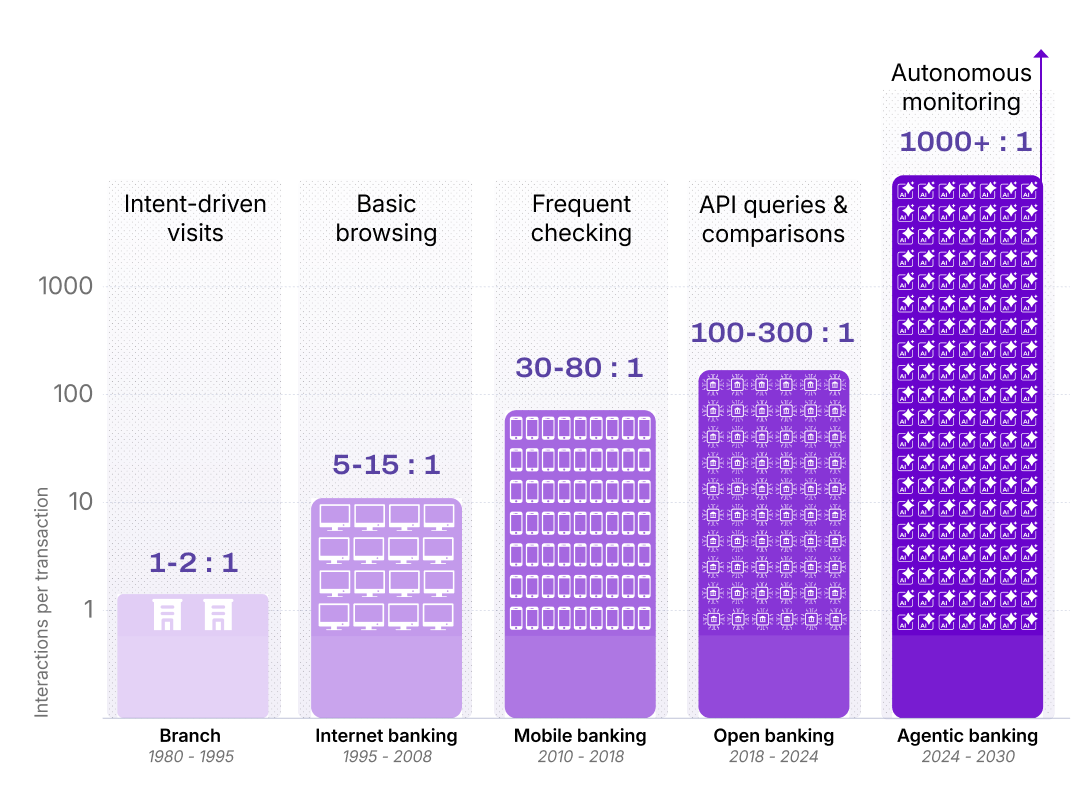
Agents could also erode one of banking's quiet advantages, customer inertia. When an agent can move savings to a better rate in seconds, deposits that once stayed put by default become much more mobile.
That doesn’t mean every bank must own the customer relationship. Some may choose to compete through Banking-as-a-Service, partnerships or other distribution models. But the choice must be deliberate, grounded in where the bank can create and capture value.
Banks that fail to make that choice will find others have made it for them.
Why do most agentic AI projects fail?
As AI makes experimentation faster, banks will generate more ideas and proofs of concept than ever before. But demonstrating what is possible is not the same as delivering it. Gartner expects more than 40% of agentic AI projects to be cancelled by the end of 2027, citing rising costs, unclear value and inadequate risk controls.
A prototype only has to work once. A banking service has to work for millions of customers, every day, under regulatory scrutiny, and still pay its way.
These requirements must shape innovation from the outset. AI can accelerate development, but it can’t compensate for fragmented technology and data, or inadequate controls. As engineering accelerates, the challenge shifts from building capabilities to getting them safely into production. AI can help streamline testing, approvals and risk assessment, but banks still need the governance, operational resilience and commercial discipline to deliver at scale.
The competitive advantage will belong to banks that can turn AI experimentation into differentiated products and services that deliver commercial value at scale.
Trust becomes the licence to compete
The moment AI moves from recommending financial decisions to acting on them, the stakes change. An inaccurate answer can be challenged or corrected. An autonomous agent that transfers money, executes an instruction or acts beyond its authority can create immediate financial, operational and regulatory consequences.
From intelligence to action
Greater autonomy changes the risk equation. An agent acting on incomplete information, misinterpreting instructions or interacting with compromised systems can trigger consequences extending well beyond a single transaction.
Banks can delegate activities to AI agents. They can't delegate away their accountability.
What is deterministic AI in banking?
AI models are probabilistic. They interpret information, recognise patterns and generate outputs based on learned relationships. Banking operates under different requirements. Financial transactions must be authorised, accurately processed and recorded in accordance with established rules and regulatory requirements.
AI can be probabilistic. Banking execution must be deterministic.
This doesn’t mean preventing agents from initiating transactions but separating intelligent decision-making and orchestration from controlled financial execution.
For this to work, AI needs more than access to customer information. It needs clearly defined banking context: structured data, granular events, established business rules, explicit permissions and interfaces that allow agents to interact with banking services within established guardrails.
Granularity matters for control as much as for context. If an agent's task is to schedule supplier payments, it should be given that action and nothing broader. The more precisely a platform defines its actions, the more precisely a bank can define an agent's remit.
This is where 4th-generation core banking matters most. It combines the flexibility of AI with the precision and integrity of proven banking capabilities, rather than allowing agents to recreate or bypass critical financial controls.
Who is accountable when a banking AI agent acts?
Banks need to establish what triggered an AI-enabled action, which permissions applied, what decisions or approvals occurred and how the resulting transaction was executed.
Consider a product change made in natural language. A colleague meant to set a savings rate at 4.1%, and it went live at 41%. The bank needs to know whether the error came from the person, the prompt, or the agent, and whether it caught it before any customer did.
AI introduces new questions of accountability, particularly when decisions and actions involve multiple agents, systems and human participants.
Explaining why an AI model generated a recommendation is not the same as proving that a financial action was authorised, compliant and correctly processed.
This requires enforceable controls, end-to-end traceability and clear accountability, with appropriate human oversight and intervention for higher-risk decisions or exceptions. Regulators are also increasing their scrutiny of AI, with emerging frameworks such as the EU AI Act placing greater emphasis on risk management, transparency and human oversight.
It also requires scrutiny of third-party models and services. As banks become more dependent on external AI providers, they must understand the operational, security and concentration risk those relationships introduce, which the Bank of England is now actively examining.
Security and resilience in an agentic world
AI is also changing the cyber threat landscape. Intelligent agents create new points of vulnerability, particularly when they can access sensitive information, initiate actions or interact with other agents and systems.
Banks will need strong agent identity, the ability to suspend an agent and contain a failure instantly, and testing for what happens when instructions conflict, systems fail or agents act unexpectedly.
The objective is not to eliminate every possible AI failure, but instead to make sure failures of an AI agent don’t automatically become failures of the bank.
Do customers trust AI to move their money?
These requirements are more than risk and compliance obligations.
Customers may already trust AI to analyse their finances or recommend a course of action. Letting it move money is different. Only 23% of US consumers trust generative AI to make payments for them, yet 61% would trust Visa to do so. Trust follows the institutions people already rely on with their money, and in the UK, consumers rank their own bank first.
In an increasingly autonomous financial system, trust won’t be defined by what banks promise their AI can do, but by what they can prove it will do safely, securely and reliably.
What separates the banks that will win with AI?
The most successful bank of the next decade may not even exist today.
But the opportunity is not limited to new entrants. Established banks have valuable assets, including customer relationships, financial data, regulatory expertise and trust. The question is whether they can capitalise on those advantages before others redefine what customers expect from banking.
Four questions belong at the centre of every banking leadership team's AI strategy.
1. Are you using AI to fundamentally change your economics?
There is a difference between using AI to make existing processes more efficient and using it to change the economics of the business.
The first delivers productivity gains. The second makes entirely new propositions, customer segments and operating models viable.
Changing the economics also means redesigning work. The AI-centric bank combines people and agents. Agents take on repetitive, complex and monotonous work; people focus on judgement, relationships and oversight, particularly in sensitive customer situations where empathy and personal support are essential. That demands new skills, smaller teams of skilled engineers directing agents, and leaders who can change the organisation at the speed the technology allows.
2. Do you know where you want to differentiate?
Banks need to decide which customer problems they are uniquely positioned to solve, where their proprietary data and relationships create an advantage, and which capabilities are better sourced through partners or established platforms.
Some banks will compete by owning the customer experience. Others will create greater value by providing specialised financial products or regulated capabilities through broader ecosystems.
Neither model guarantees success. What matters is making a deliberate choice about where the institution will compete, what it needs to own and how it intends to capture value.
The danger is not choosing the wrong AI model. It is failing to choose a distinctive business model.
3. Are you building the foundations for a future you can’t yet predict?
AI ambition is easy to articulate, but delivering on it is much harder.
Modernisation need not mean replacing everything. Banks must identify which elements of their existing infrastructure support their ambitions and which impose constraints that AI alone can’t overcome. In research we commissioned in 2024, 55% of banks said the limitations of their existing core were the biggest obstacle to their business goals.
The strategic risk is investing heavily in AI innovation while leaving the underlying limitations of the business untouched.
4. Can you turn intelligence into trusted action?
The ability to act, not just advise, will be one of AI's most significant contributions to banking.
Banks must determine where AI agents can act independently, where human oversight remains necessary and how permissions, financial controls and regulatory obligations will be enforced.
Institutions that strike the right balance between autonomy and control will move further and faster than competitors held back by uncertainty about risk.
The strategic choice ahead
AI offers an opportunity to fundamentally rethink how banking creates value. The next competitive divide will be shaped by the ambition of banks' choices and their ability to execute them. The winners will be those that translate that ambition into differentiated customer experiences, new business models and trusted services that deliver lasting advantage.
The strategic choice ahead
In the future, customers may no longer think in terms of banking products or even individual banks. Intelligent agents could help them manage financial decisions across providers, while financial services become increasingly embedded in the moments and businesses where they are needed.
The institutions that thrive will be those that decide what role they want to play in that world. Some will own trusted customer relationships and deliver distinctive experiences. Others will provide the specialised products and regulated capabilities that enable a much broader financial ecosystem.
That future is not predetermined. Banks can choose whether to use AI to preserve familiar models or to fundamentally rethink how financial services create value. The most consequential decisions will concern the customers they serve, the relationships they own and the capabilities they choose to make indispensable.
AI will not change the rules of banking competition overnight. Today's clearest gains are still emerging within technology and operations, while customer-facing agentic banking will develop as capabilities mature and trust grows. But the industry has a history of overestimating technology's short-term impact and underestimating its long-term impact.
Banking could look fundamentally different within ten years. The decisions that determine which institutions are ready will be made much sooner.
The winners in the next era of banking won't necessarily be those that invest most heavily in AI. They will be those with the strategic judgement to recognise how profoundly the rules are changing, the courage to make choices others hesitate to make, and the foundations to turn those choices into reality.
Frequently asked questions
How are banks using AI for core banking transformation?
Banks can use AI to accelerate core banking integration, migration, discovery and testing, support product development and interpret granular account and transaction data. AI can reduce engineering effort, but works best when it builds on proven banking capabilities rather than recreating regulated processes or bypassing financial controls.
How can AI change the economics of core banking transformation?
AI can reduce the manual effort involved in understanding legacy estates, mapping data, building integrations, generating migration tools and testing new capabilities. This can shorten delivery cycles and change the business case for core banking modernisation, although AI cannot remove fragmented data, undocumented dependencies or technology debt on its own.
Why does granular core banking data matter for AI?
Granular core banking data gives AI the context needed to understand accounts, transactions, events and changing customer circumstances. Rich, structured data can help banks turn generic AI capabilities into more relevant products, customer experiences and financial decisions.
How can banks combine probabilistic AI with deterministic execution?
AI models can interpret information and decide what should happen, but banking execution needs deterministic controls. Core banking systems can enforce rules, permissions and product conditions so that AI-driven decisions result in predictable, auditable financial outcomes.
What guardrails do AI agents need in banking?
AI agents in banking need explicit permissions, limited access to defined actions, enforceable product and transaction rules, end-to-end traceability and appropriate human oversight. These AI guardrails should be embedded in the banking infrastructure so agents can act without bypassing the controls governing financial outcomes.
How can banks move agentic AI from pilot to production?
Moving agentic AI in banking from pilot to production requires more than a successful proof of concept. Banks need structured data, proven banking capabilities, clear permissions and accountability, and must demonstrate that AI-enabled services remain secure, reliable and economical at scale.
Should banks build or buy core banking capabilities in the AI era?
Banks should build where proprietary data, customer insight or a distinctive customer experience creates competitive advantage, while using proven core banking platforms such as 10x Banking for foundational capabilities that do not differentiate them. AI may make software faster to create, but banks still have to assure, operate and maintain what they build over the long term.
Related resources
CORE BANKING PLAYBOOK SERIES
Part 1 —> How to buy a 4th-gen core banking system
Part 2 —> How to migrate to a 4th-gen core banking system
Part 3 —> How to unlock commercial value from your 4th-generation core


