


Summary
-
Core banking modernisation means replacing or upgrading the technology infrastructure that processes a bank's accounts, transactions, products and customer records with a modern, cloud-native platform.
-
It is a business transformation programme, not a technology upgrade. Data migration, integration management, dependency discovery and organisational change all sit inside its scope.
-
There are three distinct approaches, and they are not interchangeable: brownfield migration, neo-core pivot, and greenfield launch. Confusing them is a common cause of stalled evaluation processes.
-
Timeline depends entirely on approach and institutional complexity, not on vendor choice alone.
-
AI tooling has materially reduced migration risk by compressing tasks, such as dependency mapping, that once took months into weeks.
Quick navigation:
What is core banking modernisation? | Why now? | Three approaches | What success looks like | Timeline | Risk | FAQ
What is core banking modernisation?
Core banking modernisation is the process of replacing or upgrading a bank's core banking system, the technology infrastructure that processes accounts, transactions, products and customer records, with a modern, 4th-generation cloud-native core banking platform. It encompasses data migration, integration management, dependency discovery and organisational change, and is typically treated as a multi-year business transformation programme rather than a technology upgrade.
That last distinction matters more than most vendors admit. A technology upgrade replaces one system with a faster version of the same thing. A modernisation programme changes what the institution is capable of: how quickly it can launch products, how it processes transactions, and how much of its operating model still depends on engineering to make a routine change.
The term gets used loosely across the industry to describe at least three different kinds of programme, each with a different risk profile, timeline and starting point. Conflating them is one of the most common reasons evaluation processes stall before they start.
Why are banks modernising core banking now?
Most legacy core banking systems were built for a world of overnight batch processing: transactions reconciled once a day, products defined in code, and change delivered through engineering release cycles measured in months.
That architecture is now a structural constraint, not a technical inconvenience. Banks running on it cannot offer real-time payments, cannot adjust pricing or product terms without an engineering ticket, and cannot connect AI tooling to live operational data because the data itself is historical by the time it's available.
The pressure to modernise is coming from three directions simultaneously: customer expectations shaped by real-time digital experiences elsewhere, competitive pressure from institutions that have already modernised, and the compounding cost of maintaining ageing infrastructure that becomes more expensive and more fragile every year it remains in place.
What are the three approaches to core banking modernisation?
Core banking modernisation is not one type of programme. Financial institutions typically fall into one of three distinct situations, and the right approach depends on which one applies.
Brownfield migration describes established institutions moving off monolithic legacy estates. This is the most common scenario for Tier 1 and Tier 2 retail banks, building societies and mutuals running on ageing mainframe or first-generation infrastructure. It requires managing live operations throughout the transition, which is what makes it the most operationally complex of the three.
Neo-core pivot describes banks leaving first-generation neo-core systems that have hit their limits. A cohort of digital-first and challenger banks built on early neo-core platforms in the last decade are now finding those systems constrain the same things legacy infrastructure once did: product flexibility, real-time data, and the ability to extend the platform without vendor dependency.
Greenfield launch describes new propositions built from scratch on modern infrastructure. This applies to new banking brands, embedded finance propositions, and institutions launching a new product line separately from their existing estate. It carries the lowest migration risk because there is no legacy system to run in parallel, but the architecture decisions made at launch still determine the institution's technical ceiling for the next decade.
These archetypes are not interchangeable, and the language matters. A vendor or consultant using "modernisation" to describe all three without distinguishing between them is a signal to ask more questions, not fewer.
What does a successful core banking modernisation look like in practice?
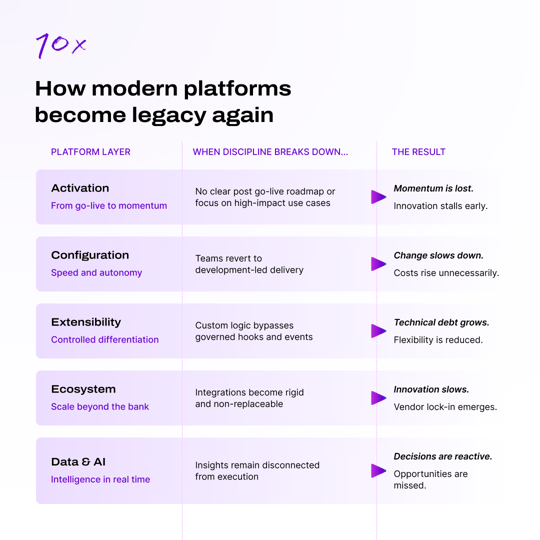 Success in core banking modernisation is not defined by reaching go-live without disruption, although that is a necessary condition. It is defined by what the institution can do differently afterwards: launching products without an engineering release, adjusting pricing in hours rather than months, and connecting real-time data to decisioning rather than working from yesterday's batch export.
10x Banking has been proven through transformational deployments including Chase UK, Old Mutual, West Brom Building Society and Westpac, across brownfield migrations, neo-core pivots and greenfield launches. Each of those institutions approached modernisation as an operating model change, not simply an infrastructure replacement, which is the pattern most consistently associated with realising the intended value after go-live.
The risk that undermines otherwise successful modernisation programmes is treating go-live as the finish line. A modern core creates the conditions for continuous product agility, extensibility and real-time intelligence. It does not deliver those things automatically. Institutions that stop investing in operating discipline after cutover can find themselves recreating the constraints they just spent years removing, a pattern worth understanding in its own right before committing to a modernisation programme.
How long does core banking modernisation take?
Timeline varies significantly by approach and institutional complexity. Big bang replacements can be completed over a compressed window for simpler environments. Phased migrations at large, complex institutions typically run over several years. Institutions that hollow out the core deliberately, being intentional about what they take forward and what they retire, can migrate considerably faster than those that attempt to carry every legacy process across unchanged. Greenfield builds allow new propositions to launch quickly, with full migration of legacy portfolios, where relevant, occurring in parallel over time.
There is no single answer to "how long will this take" that applies across institutions. The honest answer depends on the archetype, the state of the existing data estate, and how disciplined the institution is prepared to be about what it actually needs to carry forward.
What are the risks in core banking modernisation, and how are they managed?
The risks in core banking modernisation are not primarily about the destination platform. They are about the discipline applied to getting there.
Data complexity is the most consistently underestimated risk. Legacy banking estates almost never have a single source of truth. Deposits, lending and product data typically sit in separate systems with different data models and business rules. Before migration, institutions must understand where all data lives, what it means in each context, what regulatory retention requirements apply, and what they actually want to carry forward versus retire.
Dependency risk follows closely behind. Legacy cores accumulate years of point-to-point integrations that are rarely fully documented. Mapping those dependencies before cutover, rather than discovering them during it, is what separates a controlled migration from a disrupted one.
Organisational risk is the least discussed and often the most consequential. A modernisation programme that changes the technology without changing the operating model built on top of it tends to underdeliver. Business and product teams need to be equipped and empowered to use the new platform's capabilities, not just migrated onto it.
AI tooling has materially reduced the unknown unknowns that have historically made migration so risky. Tasks such as reverse-engineering legacy code and mapping integration dependencies, which once took months, can now be completed in weeks. This improves an institution's ability to understand its own estate before committing to cutover. It does not eliminate migration risk, but it changes the information available to manage it.
Frequently asked questions
What is core banking modernisation? Core banking modernisation is the process of replacing or upgrading a bank's core banking system, the technology infrastructure that processes accounts, transactions, products and customer records, with a modern, cloud-native platform. It encompasses data migration, integration management, dependency discovery and organisational change, and is typically treated as a multi-year business transformation programme rather than a technology upgrade.
How long does a core banking migration take? Timeline varies significantly by approach and institutional complexity. Big bang replacements can be completed over a compressed window for simpler environments. Phased migrations at large, complex institutions typically run over several years. Institutions who hollow out the core and are intentional about what they take forward can migrate far faster. Greenfield builds allow new propositions to launch quickly, with full migration of legacy portfolios occurring in parallel over time.
What is the difference between brownfield migration, a neo-core pivot and a greenfield launch? Brownfield migration describes established institutions moving off monolithic legacy estates while managing live operations throughout. A neo-core pivot describes banks leaving first-generation neo-core systems that have hit their limits on product flexibility and real-time data. A greenfield launch describes new propositions built from scratch on modern infrastructure, with no legacy system to run in parallel. Each carries a different risk profile and timeline, and the right approach depends on which situation the institution is actually in.
What makes data migration in core banking so complex? Legacy banking stacks almost never have a single source of truth. Deposits, lending and product data typically sit in separate systems with different data models and business rules. Before migration, banks must understand where all data lives, what it means in each context, what regulatory retention requirements apply, and what they actually want to carry forward versus retire.
How is AI changing core banking migration? AI tooling has materially reduced the unknown unknowns that have historically made migration so risky. Tasks such as reverse-engineering legacy code and mapping integration dependencies, which once took months, can now be completed in weeks. This improves a bank's ability to understand its own estate before committing to cutover. It does not eliminate migration risk, but it changes the information available to manage it.
What is a 4th-generation core banking platform? A 4th-generation core banking platform is a cloud-native, event-driven, API-first architecture built on microservices. Unlike legacy mainframe or first- and second-generation platforms, it supports real-time data processing, multi-tenancy, and continuous product development without requiring changes to underlying infrastructure. It is designed to enable banks to build, iterate, and scale financial products without rebuilding commodity code.
Is core banking modernisation the same as core banking migration? Not quite. Migration refers to the technical and operational process of moving from one core system to another; it is a project with an end date. Modernisation is the broader outcome: adopting a modern architecture and the operating capabilities that come with it. A migration can be completed without the institution having actually modernised, if the operating model built on top of the new platform doesn't change.
Related resources
CORE BANKING PLAYBOOK SERIES
Part 1 —> How to buy a 4th-gen core banking system
Part 2 —> How to migrate to a 4th-gen core banking system
Part 3 —> How to unlock commercial value from your 4th-generation core


