When the rubber hits the road: a practical guide to buying, migrating, and extending a 4th-generation core banking system. In Part 1, we covered how to buy a true 4th-generation core. In this second part, we explore how institutions can migrate to their chosen platform. And in part 3 we examine how that core can be extended to achieve technical autonomy without accumulating technical debt
Choosing a next-generation core is only half the challenge. If you cannot migrate to it successfully, the decision is academic.
Core migration is often framed as a technology problem. In reality, it is much more. It is a business and execution challenge that tests how effectively an institution can lead, govern, and adapt through transformation.
Its consequences are immediate. Migration shapes timelines, costs, and risk exposure and ultimately determines whether the value of transformation is realized in both business outcomes and customer experience.
So what actually separates a successful core migration from one that fails?
This playbook answers that with a practical, execution-focused breakdown of what it really takes to deliver a successful core migration.
Get your free guide
Submit the form and receive the report directly in your inbox.
The core migration questions this guide answers
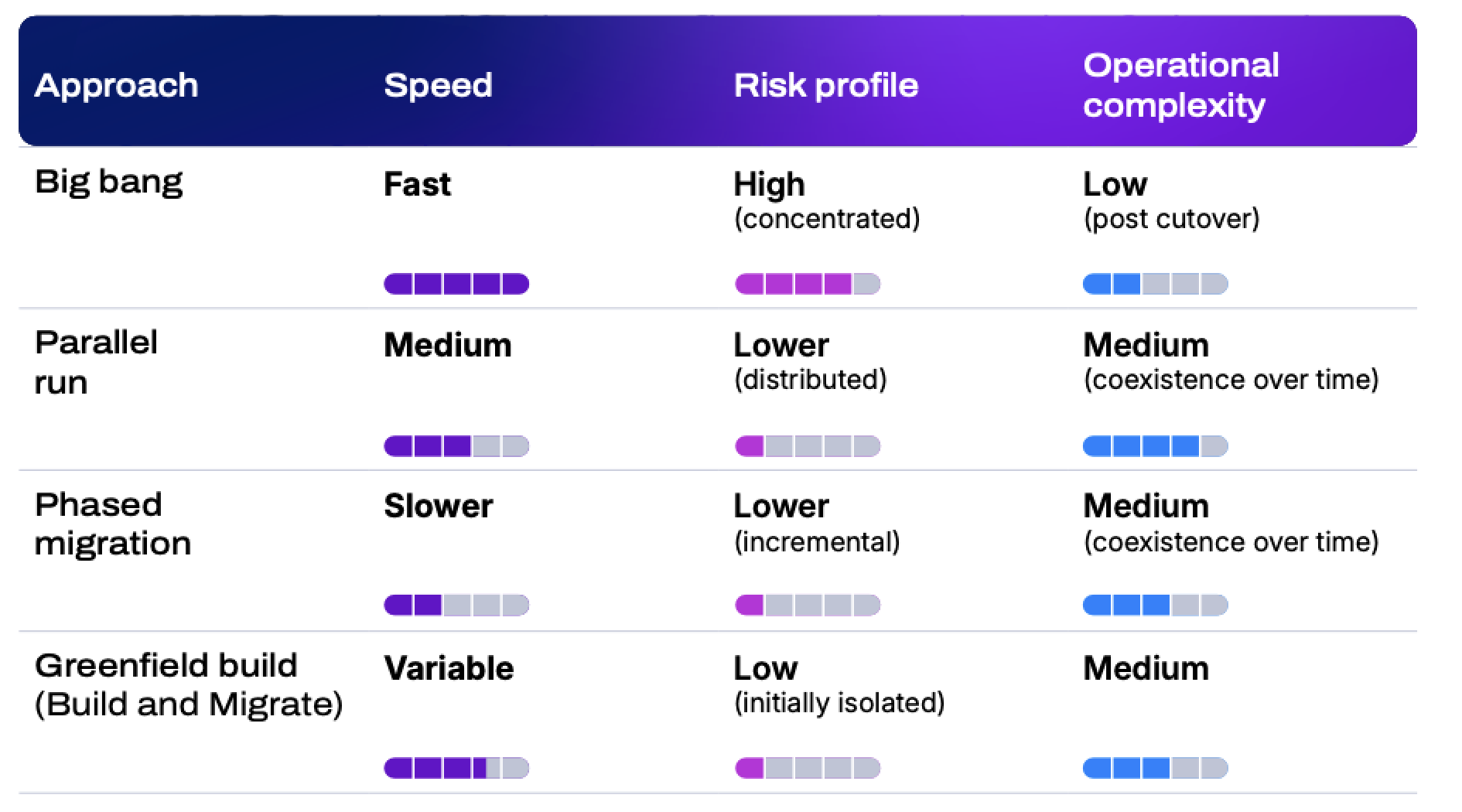
What does the right core banking migration approach look like?
There is no single best approach. The right model depends on your organization’s complexity, risk appetite, and strategic priorities.
Inside the playbook: Understand the trade-offs between big bang, phased, parallel run and build-and-migrate approaches, and how institutions are selecting based on complexity, risk appetite and strategic priorities.
How do you manage dependencies and coexistence without increasing complexity?
Core systems are deeply interconnected, making dependency management one of the most complex aspects of migration. Hidden interdependencies can delay progress, introduce risk, and increase cost if not identified early.
Inside the playbook: Explore why coexistence has become the default, and how to manage the complexity of running two systems in parallel.

How is AI changing core banking migration execution?
AI is beginning to reshape how migration programs are delivered, moving from isolated experimentation to practical application.
It does not remove the need for governance, control, or accountability. Instead, it amplifies the importance of getting those fundamentals right.
Inside the playbook: See where AI is already being used to accelerate discovery, improve data mapping, and scale testing in ways that were previously time-consuming and resource intensive.

With GenAI, you can simulate thousands of scenarios, uncover hidden behaviors, and validate outcomes in advance. This is shifting migration from reactive risk to proactive assurance.
Andrew Ng Head of Payments and Embedded Finance, TungstenWhy do core banking migrations fail and how can you avoid it?
Despite advances in technology, many migration programs still fail to deliver on their objectives. The causes are rarely technical. More often, they come down to execution.
Common failure points include poor data quality, underestimated dependencies, lack of alignment between business and technology teams, and weak governance structures.
Inside the playbook: Understand why executive alignment, experienced teams, and disciplined scope control consistently define successful programs.
What's inside


Get your free guide
Ready to reduce risk and deliver a successful core migration?
Submit the form and receive the report directly in your inbox.