Our Senior Communications & Impact Manager, Franky Kentish, shares her insights the future of fintech and the importance of impact following IFGS 2026.
I never expected the opening of the Innovate Finance Global Summit in London’s ancient Guildhall to begin with the phrase, “I’m going to strip off,” but that is exactly how Chris Hayward from the City of London Corporation started proceedings.
Admittedly, the only stripping was a symbolic discarding of his tie. But that image of throwing away constraint in an old institution was a powerful one for conveying the landscape of today’s UK fintech scene. A marriage between the incredible legacy of historic organizations and the innovation of newer ones that help us throw out what holds us back. Ultimately, this dialogue between old and new benefits the end customer and, more broadly, society.
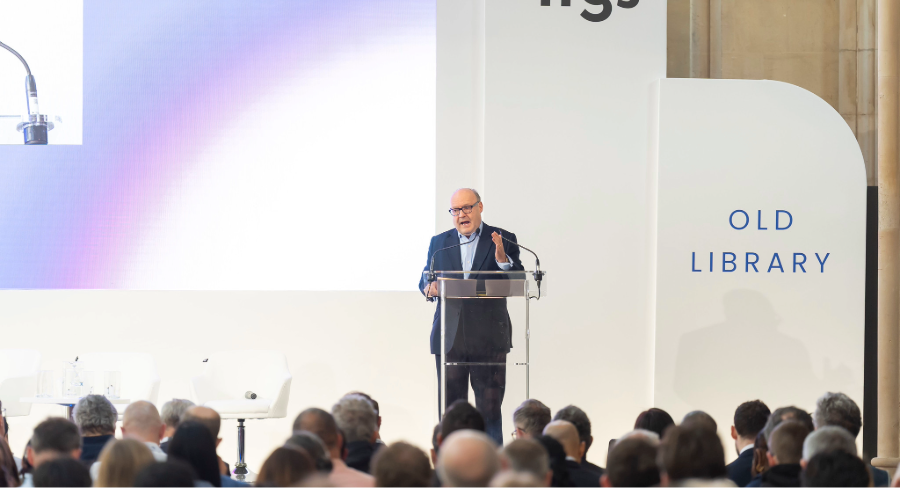
Chris Hayward after discarding the legacy tie
It is a familiar story to us at 10x Banking, where we are experienced in partnering with iconic financial institutions. They bring a wealth of experience, customers, and product ideas, while we help them break free from legacy technology that no longer serves them, enabling our clients to better support everyone from large corporates to underserved SMEs that rely on modern, responsive financial services to grow.
The pace problem
The UK’s financial services sector has an extraordinary legacy: deep expertise, global trust, centuries-old institutions, and an ecosystem that is consistently recognized as exemplary on the world stage. None of that was in dispute at IFGS 2026.
However, a clear message echoed across the panels: we cannot rest on this reputation and default to inertia if the industry wishes to retain its crown.
Panelists throughout the day agreed that alignment across industry, regulators, and policymakers is the best it has ever been, but one of the biggest challenges is now pace. Several speakers made the point that execution is now the differentiator. Ideas, frameworks, and ambition only matter if they turn into tangible progress quickly enough to keep up with change.
If the UK wants to lead, it has to be bold
Early in the day, a recurring theme began to take shape: the UK can continue to lead in the fintech space, but we need to be bolder and take more risks.
That point was made explicitly in the opening panel by Antony Jenkins, CEO & Founder of 10x, who said, “We have to be bold and we have to be ambitious... It’s not on government, it’s on us. The government has to create the conditions, but we fintechs have to do the work. That’s the bottom line.” This was echoed by Richard Davies, CEO of Allica Bank, in the opening panel.

We have to be bold and we have to be ambitious... It’s not on government, it’s on us
Antony Jenkins CEO & Founder, 10x BankingWe are operating in an environment where technology is advancing rapidly, customer expectations continue to rise, and global competition for talent and capital is real. In that context, standing still is not an option.
Risk-taking is shaped by who’s in the room
One of the contributions that struck me most came from non-executive director Samantha Emery, who made a clear link between diversity, risk, and economic growth. As she put it, if you do not have people in leadership who are representative of the customers and communities you serve, you will have massive blind spots and miss unexpected areas of opportunity. The best way to mitigate risk while feeling confident enough to take bold steps is to create a leadership layer with true diversity of thought.
A solution was put forward by Antony, who discussed the importance of partnering with universities to secure a broader and more diverse talent pipeline that can meet the industry’s evolving needs. Long-term growth requires more than recycling experienced hires; it depends on actively widening the door.
Nadia Edwards-Dashti of Harrington Starr also touched on this, emphasizing the importance of hiring for potential – people who are motivated by challenge and change, not simply bringing proven track records.
From where I sit, this matters enormously. Transformation is not achieved solely through strategy decks, technology roadmaps, or government legislation. It happens through people who are willing to question assumptions, learn quickly, and act.
Inclusion as an economic unlock, not a side issue
One of the most encouraging aspects of the day for me personally was the prominence given to inclusion. An entire stage was dedicated to inclusivity in financial services as an unlock for economic growth, not framed as corporate virtue signaling, but as a fundamental design and leadership issue.
Speakers talked about accessibility, representation, and intentional design, particularly the risk of excluding large portions of the population through narrow assumptions about user behavior. The argument is straightforward but powerful: inclusion leads to better decisions, broader reach, and stronger economic participation.
This is something we take seriously at 10x. We are B Corp certified and a member of the UN Global Compact because we believe technology should be a force for good, not just through modernizing systems, but by widening access to better financial services and opportunity.
We need each other to succeed
Another strong undercurrent throughout the summit was the importance of partnerships and ecosystems.
No one argued that banks, fintechs, or other players can or should do everything alone. Instead, there was repeated emphasis on the value of combining strengths: scale and trust from established institutions, agility and innovation from technology platforms, and shared ambition across the ecosystem.
The UK fintech ecosystem still has enormous strengths: expertise, institutions, talent, and a culture of collaboration. Retaining leadership will depend on whether we are willing to keep loosening the tie and take the bold steps needed to transform the future of financial services.
Continue the conversation